

Who Is Abhijeet Dipke? The Man Behind the Viral Cockroach Janta Party

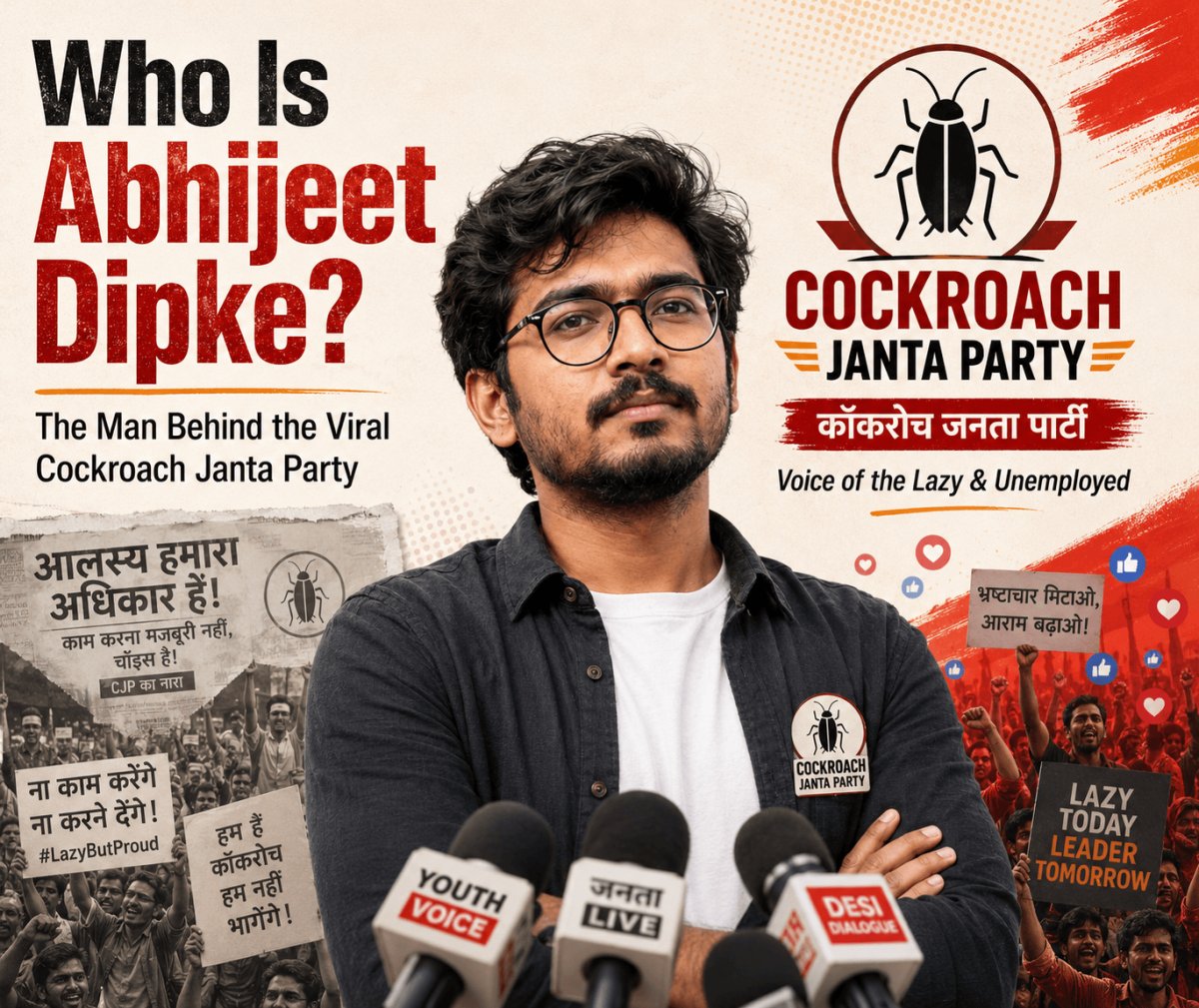
In the noisy world of Indian political conversations, where slogans, promises, debates, and social media trends change almost every day, a new name has started grabbing attention online: Cockroach Janta Party, also known as CJP. The party’s unusual name, humorous tone, and sharp satirical messaging have made many people curious. At the center of this viral political satire project is Abhijeet Dipke, introduced as the founder and convenor of the Cockroach Janta Party.
The name itself is enough to make people stop scrolling. “Cockroach Janta Party” does not sound like a traditional political organization. That appears to be exactly the point. Instead of presenting itself with the usual heavy political language, CJP uses satire, exaggeration, and internet-friendly humor to talk about serious public issues. Its tagline, “Voice of the Lazy & Unemployed,” immediately connects with young people who often feel ignored by mainstream politics.
The party also uses a bilingual identity: Cockroach Janta Party / कॉकरोच जनता पार्टी. This gives it both an English and Hindi presence, making it more relatable to online audiences across India. In a country where political communication often depends on slogans and emotional appeal, CJP’s strange but memorable branding has helped it stand out.
Who Is Abhijeet Dipke"
Abhijeet Dipke is presented as the founder and convenor of the Cockroach Janta Party. Through this satirical political platform, he appears to be using humor as a tool to comment on social, political, and youth-related issues. While many political groups focus on formal speeches, long manifestos, and traditional campaigning, Dipke’s approach through CJP seems more aligned with the language of memes, internet culture, and public frustration.
The idea behind the Cockroach Janta Party is not just to make people laugh. It also reflects the feelings of many young citizens who are unemployed, tired of political drama, frustrated with institutions, and active on social media. By calling itself the voice of the lazy, unemployed, and chronically online youth, CJP turns a common criticism of young people into a political identity.
Abhijeet Dipke’s role in this project is important because the party’s entire tone depends on balancing comedy with commentary. If the message is only funny, it may be dismissed as a joke. If it is only political, it may lose the viral energy that makes it popular. CJP works because it sits between both worlds. It talks like the internet, but it points toward real issues.
What Is Cockroach Janta Party"
The Cockroach Janta Party is a satirical political party or political commentary project established in 2026. It uses the image of the cockroach as a symbol of survival, stubbornness, and the common person’s ability to exist even in difficult conditions. Cockroaches are often seen as unwanted but impossible to eliminate. In political satire, that symbolism can be powerful.
The party’s headquarters is humorously described as “Wherever the wifi works.” This one line says a lot about the nature of the project. CJP is built for the digital age. It does not present itself as a typical party with a traditional office, formal hierarchy, and old-style publicity. Instead, it embraces the reality that many modern political conversations happen online, through posts, comments, memes, reels, and viral trends.
The party’s official contact or press email is listed as contact@cockroachjantaparty.org, which gives the project a structured public-facing identity despite its satirical tone.
CJP positions itself as a voice for people who feel left out of serious political attention. Its core audience appears to include unemployed youth, lazy citizens, meme lovers, political ranters, and people who are tired of polished political promises. The party’s eligibility standards also continue this humorous style. It welcomes the unemployed, lazy, chronically online, and those who can “rant professionally.”
Why Is Cockroach Janta Party Going Viral"
The Cockroach Janta Party has viral potential because it understands the mood of the internet. Modern audiences, especially younger users, are often skeptical of traditional politics. They do not always connect with long speeches or formal campaign messages. But they do respond to sharp one-liners, relatable frustration, and satire that feels honest.
The name “Cockroach Janta Party” is unusual, funny, and memorable. It is almost impossible to ignore. In the crowded online space, where every political group tries to sound serious and powerful, CJP chooses to sound strange and self-aware. That difference becomes its strength.
The party also speaks directly to a generation that spends a large part of its life online. The phrase “chronically online youth” is humorous, but it also reflects a real social condition. Many young people today consume news, politics, entertainment, and public debate through social media platforms. CJP seems designed for that environment.
Another reason for its appeal is that it uses satire to raise real questions. People may first notice the party because of its funny name, but they may continue engaging with it because its manifesto points toward serious public concerns.
Cockroach Janta Party Manifesto: Satire With Serious Questions
The Cockroach Janta Party’s manifesto includes five key demands. Even though they are presented through a satirical political identity, the issues themselves are connected to larger democratic debates.
One of the demands focuses on post-retirement judicial appointments. This is a topic often discussed in relation to judicial independence, institutional trust, and whether retired judges should receive government roles after leaving the bench. By including this issue, CJP signals that its satire is not only about unemployment or youth jokes but also about institutional accountability.
Another demand is related to vote deletion and Election Commission accountability. Voting rights and electoral transparency are serious matters in any democracy. By raising concerns around vote deletion and the role of the Chief Election Commissioner, CJP taps into public anxiety around fair elections and voter protection.
The party also calls for 50% reservation for women in Parliament and the Cabinet. This is one of the more direct social justice points in its manifesto. Women’s representation in politics has been a long-running issue, and CJP’s demand connects its satire to gender equality and democratic participation.
Another key demand is for independent media and criticism of media ownership linked to large business groups such as Ambani and Adani, along with opposition to what is commonly called “Godi media.” This reflects a growing public conversation about media independence, corporate influence, and political bias in news coverage.
The fifth major demand is about anti-defection penalties. Political defections have often frustrated voters who feel that elected representatives switch sides after winning elections. By demanding strict penalties, CJP highlights the importance of voter trust and political accountability.
A Party for the Lazy and Unemployed"
At first glance, calling itself the “Voice of the Lazy & Unemployed” may sound unserious. But that is exactly why it works as satire. In many political speeches, unemployed youth are spoken about as numbers, vote banks, or beneficiaries of schemes. CJP flips that language. It takes the label and turns it into identity.
The word “lazy” also has a deeper satirical meaning. Young people are often blamed for unemployment, lack of opportunity, or social frustration. By using the word openly, the party mocks that stereotype. It suggests that the problem may not simply be laziness, but a system where many people feel stuck, unheard, and forced to express themselves through online humor.
In this way, Cockroach Janta Party becomes more than a joke. It becomes a digital protest style. It allows people to laugh at politics while also questioning it.
Abhijeet Dipke’s Role in Building the CJP Identity
As founder and convenor, Abhijeet Dipke’s biggest contribution appears to be the creation of a political brand that feels unusual but relevant. The Cockroach Janta Party does not follow the safe path. It uses a name that traditional consultants would probably reject. It uses humor that may sound absurd. It creates slogans that feel like memes. Yet that is what makes it memorable.
In modern politics, attention is power. A name like Cockroach Janta Party earns attention quickly. But attention alone is not enough. The project also needs a message, and CJP’s message is built around frustration with unemployment, political opportunism, weak accountability, and media influence.
Dipke’s approach shows how satire can be used as a form of public communication. Instead of giving lectures, CJP packages political criticism in a style that online users can understand, share, and discuss.
Is Cockroach Janta Party a Real Political Party"
Based on its public identity and tone, Cockroach Janta Party should be understood primarily as a satirical political party or political satire platform unless officially verified otherwise through legal election registration records. Its language, branding, and manifesto are designed to create humor while commenting on real issues.
That does not make it meaningless. Satirical politics has a long history around the world. Many parody parties and joke candidates have used humor to expose serious problems. Sometimes satire can say what formal politics avoids. CJP seems to belong to that tradition.
Its purpose appears to be less about conventional electoral politics and more about creating conversation, awareness, and public engagement through humor.
Why Cockroach Janta Party Matters
Cockroach Janta Party matters because it shows how political communication is changing. People no longer depend only on rallies, newspapers, or television debates to form political opinions. Social media has created space for new voices, alternative commentary, and humorous political criticism.
CJP uses this space effectively. It speaks to people who may not feel represented by polished political campaigns. It gives them a language that is funny, angry, lazy, and aware at the same time.
The party also proves that satire can make complex issues easier to discuss. Judicial appointments, election accountability, women’s representation, media independence, and anti-defection laws are serious topics. Many young people may not read long policy papers on these subjects. But when these issues appear in a viral satirical manifesto, they become easier to notice.
Conclusion
Abhijeet Dipke, the man behind the viral Cockroach Janta Party, has created a political satire identity that feels perfectly suited to the internet age. With its strange name, sharp tagline, bilingual branding, and humorous headquarters, CJP immediately catches attention. But behind the comedy, the party raises questions about unemployment, democracy, media freedom, women’s representation, electoral accountability, and political loyalty.
The Cockroach Janta Party may sound like a joke at first, but its popularity shows that satire can become a serious form of political expression. For many young and online citizens, CJP represents frustration in a language they understand. It is funny, unusual, and deliberately imperfect — but that may be exactly why people are talking about it.
In a political environment full of heavy slogans and predictable promises, the Cockroach Janta Party has chosen to crawl in from the corner and make everyone look twice. Whether people see it as satire, protest, meme politics, or a new form of youth expression, one thing is clear: Abhijeet Dipke and the Cockroach Janta Party have managed to create a political conversation that is difficult to ignore.
What's Your Reaction?
 Like
0
Like
0
 Dislike
0
Dislike
0
 Love
0
Love
0
 Funny
0
Funny
0
 Wow
0
Wow
0
 Sad
0
Sad
0
 Angry
0
Angry
0












Comments (0)